
Navigating funeral etiquette in Singapore can be confusing, especially regarding “condolence money” or Bai Jin. While there is no fixed rule, the amount primarily depends on your relationship with the deceased. For acquaintances, $30 to $50 is standard.
For friends and colleagues, $50 to $100 is appropriate. Close family members typically give $100 to $300 or more. Ultimately, sincerity matters more than the amount. This guide covers cultural nuances, religious practices, and proper etiquette to help you pay respects with confidence.
Understanding Condolence Money (Bai Jin / Pek Kim)
In Singapore, offering money at a funeral is a long-standing tradition. You will often hear this referred to as Bai Jin in Mandarin or Pek Kim in Hokkien. Both terms translate to “White Gold.”
It is important to understand that this is not a transaction. You are not paying for an entry ticket to the wake. Instead, it serves two main purposes. Firstly, it is a practical contribution. Funerals in Singapore can be expensive, involving costs for caskets, tentage setups at void decks, parlour rentals, and catering. Your contribution helps the bereaved family offset these heavy expenses.
Secondly, it is a symbolic gesture. By offering Bai Jin, you are sharing in the family’s burden. In the past, communities would come together to help a neighbour in need. Today, this tradition continues through monetary support. It is a way of saying, “I am here to support you during this difficult time.”
Factors That Determine “How Much” to Give
While we will discuss specific numbers later, the amount you give is subjective. There is no official price list. However, most people in Singapore look at four main factors when deciding on the amount.
Relationship to the Deceased
This is the most significant factor. The closer you were to the deceased or their family, the higher the expected support. A distant relative is not expected to contribute as much as a best friend or a direct sibling. The social expectation is that those closest to the family will help shoulder the financial load more significantly.
The Venue and Scale
While the relationship is the primary driver, the venue can sometimes influence the decision. A funeral held at a premium parlour generally costs the family more than a simple setup at an HDB void deck. Some guests choose to increase their contribution slightly if they know the venue costs are high, but this is not a strict requirement.
Your Financial Capability
As professional funeral service providers, we always advise guests to give only what they can afford. A funeral is a time for sincerity, not showing off wealth. If you are a student, unemployed, or on a tight budget, a small token is perfectly acceptable. The family will appreciate your presence more than a large sum that puts you in debt.
Reciprocity (Li Shang Wang Lai)
In Chinese culture, there is a concept called Li Shang Wang Lai, which means “courtesy demands reciprocity.” Families often keep a record of who gave what amount. If the bereaved family previously attended a funeral for your family and gave $100, it is polite to return the same amount or slightly more when you attend their funeral. This maintains the balance of social exchange.
Singapore Market Rates: General Consensus
If you are unsure where to start, you can follow these general market rates found in Singapore. These figures are based on current social norms.
For Acquaintances and Distant Relatives
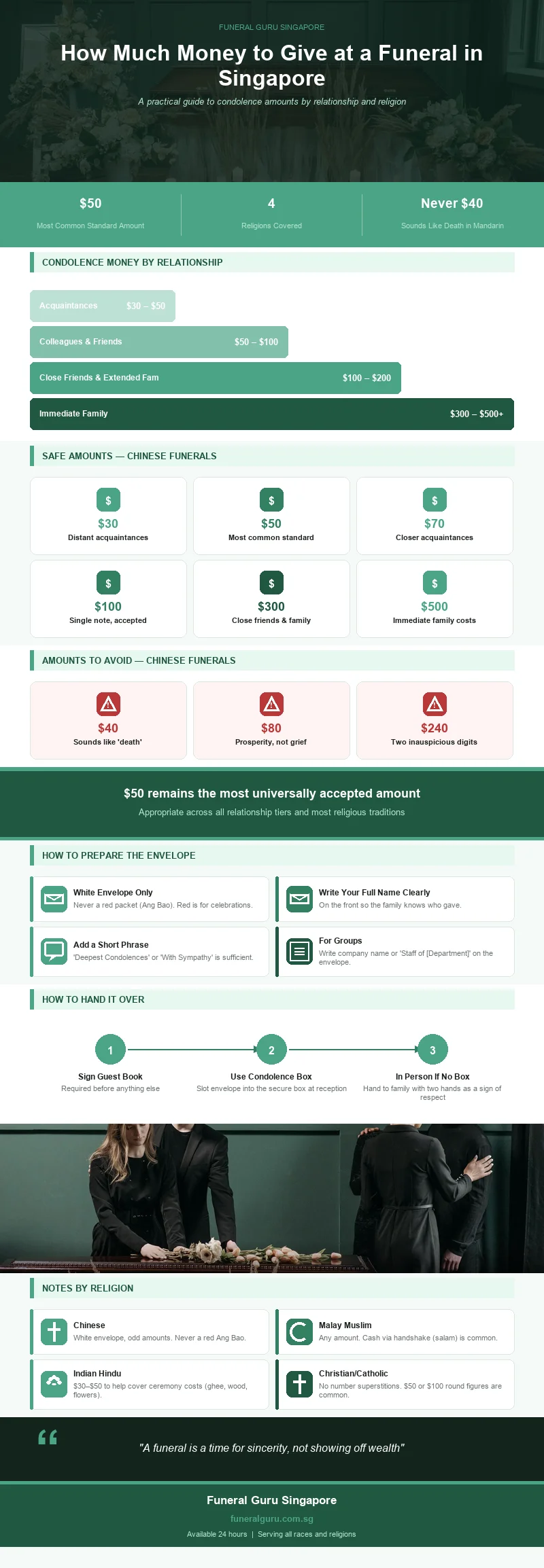
Range: $30 – $50
This category includes neighbours you say hello to but do not know well, friends of friends, or distant relatives you rarely see. Giving $30 or $50 shows that you acknowledge the loss and want to pay your respects. It is a polite and appropriate amount that does not overstep boundaries.
For Colleagues and Friends
Range: $50 – $100
This applies to people you work with daily or friends you meet occasionally for meals. $50 is considered a safe “standard” note in Singapore. It is respectable and helpful.
Department Collections: In many Singaporean offices, it is common for a department to pool money together. Each person might contribute $10 to $20, resulting in a larger lump sum from the “Staff of [Department Name].” This is a practical way to show support as a group.
For Close Friends and Extended Family
Range: $100 – $200
This range is for people with whom you share a bond. This includes first cousins, close buddies, old classmates you kept in touch with, or mentors. A contribution of $100 or more reflects a deeper relationship and offers significant support to the family.
For Immediate Family and Best Friends
Range: $300 – $500+
For siblings, parents, or best friends who are like family, the contribution is often much higher. At this level, the money is often intended to help cover the actual cost of the funeral package.
Cultural and Religious Specifics in Singapore
Singapore is a multi-cultural society, and funeral customs vary. It is important to be aware of these nuances so you do not accidentally cause offence.
Chinese Funerals (Buddhist & Taoist)
The most critical rule in Chinese funerals is the “Odd Number” Rule.
In Chinese culture, even numbers (2, 4, 6, 8) are associated with “double happiness” and auspicious events like weddings. You do not want to “double” the grief at a funeral. Therefore, the total amount you give should usually start with an odd number.
- Safe Amounts: $30, $50, $70, $100, $300, $500.
- Why is $100 okay? Even though 100 is an even number mathematically, in this context, it is viewed as a single note or starting with the digit ‘1’, making it acceptable.
- Amounts to Avoid: Never give amounts ending in 4 (sounds like “death” in Mandarin) or 8 (associated with prosperity and celebration). Avoid giving $40, $80, or $240.
Return Gifts: When you leave a Chinese funeral, the family may give you a red thread or a small coin. This is a symbolic gesture to ensure you leave the “bad luck” behind and return home safely.
Malay Muslim Funerals
In the Malay community, condolence money is often referred to as Duit Takziah. It is viewed as Sadaqah (charity) to help the bereaved family.
- No Superstitions: There are no strict rules about odd or even numbers.
- Amount: Any amount given from the heart is accepted. $10, $50, or $100 are all fine.
- Presentation: You can place the money in a white envelope or a simple green packet, but it is also common to pass the cash discreetly to a family member during a handshake (salam).
Indian Hindu Funerals
Monetary gifts are accepted at Hindu funerals, but they are generally less central than in Chinese culture.
- Focus: The focus is heavily on prayers, rituals, and your physical presence.
- Amount: Modest amounts like $30 to $50 are common to help with the costs of items used in the ceremony (like ghee, wood, or flowers).
- Etiquette: Passing the money in an envelope to the person in charge of the expenses is the best approach.
Christian and Catholic Funerals
Christian funerals in Singapore generally follow a mix of Western etiquette and local practicality.
- No Number Rules: There are no superstitions regarding odd or even numbers. $40 or $60 is perfectly fine, though round figures like $50 or $100 are more common simply for convenience.
- Purpose: The money is viewed as an offering of love and support for the widow or the family left behind.
Etiquette: How to Prepare and Give the Money
Knowing how to present the money is just as important as the amount.
Choosing the Right Envelope
For Chinese funerals, you must use a white envelope. Never use a red packet (Ang Bao), as red is for celebrations.
You do not need to rush to a stationery shop to buy one. Almost every funeral wake in Singapore, whether at a void deck or a parlour, will have a stack of white envelopes and pens at the reception table. You can simply take one when you arrive.
What to Write on the Envelope
The family needs to know who the money is from, primarily for their records and potential reciprocity in the future.
- Identify Yourself: Write your full name clearly.
- Simple Message: You can add a short phrase like “Deepest Condolences” or “With Sympathy.”
- For Groups: If you are giving on behalf of a company or a group of colleagues, write the company name or “Staff of [Department]” clearly.
When and How to Hand It Over
When you arrive at the wake, you will usually see a reception table with a guest book.
- Sign the Book: strict etiquette suggests signing the guest book first.
- The Box: There is usually a secure “Condolence Money” box on the table. You can slot your envelope in there.
- In Person: If there is no box, or if you are at a Malay or Indian funeral where boxes are less common, you can hand the envelope to a family member. Use two hands to pass it over as a sign of respect.
Is Digital Payment (PayNow) Acceptable?
Since 2020, the landscape of funeral giving in Singapore has changed. PayNow is now widely accepted and socially acceptable.
- When to use it: It is helpful if you cannot attend the wake in person, or if the family has displayed a QR code at the reception table.
- Reference Field: This is crucial. When you make the transfer, you must type your name in the “Reference” or “Comments” field. If you leave it blank, the family will see a transaction but will not know who sent it.
When Not to Give Money (Alternative Gestures)
There is one major exception to giving money. You must check the obituary or the funeral announcement.
If the family has stated “No Wreaths or Condolence Money,” you must respect their wishes. This is often done by families who wish to keep the funeral simple or who donate all proceeds to charity. Forcing money on them in this situation can be awkward and disrespectful.
What to do instead:
- Charity: If they request a donation to a specific charity (e.g., the National Kidney Foundation or a hospice) in the deceased’s name, do that instead.
- Flowers: Send a condolence wreath, but only if they have not banned flowers as well. Note that fresh flowers are generally not used for Muslim funerals.
- Banners: For traditional Chinese funerals, blankets or banners are sometimes sent, but check with the family first.
Conclusion On How Much Money Is Enough to Give in Funeral
Choosing the right amount for funeral condolence money does not have to be stressful. In Singapore, while there are general market rates, ranging from 30 for acquaintances to 300+ for close family, the most important factor is your sincerity and your relationship with the deceased. Remember to observe cultural nuances, such as the “odd number” rule for Chinese funerals and using the correct white envelope. Ultimately, your presence and support mean more to the bereaved family than the cash inside the packet.
If you are currently planning a funeral or need assistance with funeral matters, our compassionate team is here to guide you.
Contact Us at Funeral Guru for professional and reliable support.
Frequently Asked Questions About Condolence Money
How much do you give for a Chinese funeral in Singapore?
For a standard Chinese funeral, the amount typically depends on your relationship. A common rate is $30 to $50 for acquaintances, and $50 to $100 for friends. Ensure the amount usually starts with an odd number (like $30 or $50) to follow local traditions.
What is the odd number rule for funeral money?
In Singaporean Chinese custom, even numbers (like 2, 4, 8) are associated with “double happiness” or auspicious events like weddings. For funerals, you should give amounts that start with an odd number, such as $30, $50, $70, or $100, to avoid “doubling” the grief.
Do you give money at a Christian funeral in Singapore?
Yes, it is acceptable and common to give money at a Christian funeral to help the family with expenses. Unlike Chinese traditions, there are no superstitions regarding odd or even numbers, so any sincere amount is appropriate.
Is $30 enough for condolence money?
Yes, $30 is a perfectly acceptable amount for acquaintances, neighbours, or if you are a student or on a tight budget. The bereaved family values your presence and respect more than the specific monetary figure.
What do you write on a white funeral envelope?
You should write your full name clearly on the envelope so the family can record the contribution. You may also add a short phrase like “Deepest Condolences” or “With Sympathy.”
Can I PayNow condolence money?
Yes, PayNow has become a socially acceptable way to send condolence money in Singapore, especially if you cannot attend the wake. Ensure you enter your name in the reference field so the family knows who the contribution is from.